Unternehmen Shop
Welle Welle Welle Welle Welle

Vinegar quality differences at a glance

Organic vs. conventional

Vinegar is an integral part of our kitchens – whether for seasoning, pickling or refining dishes. But not all vinegars are the same. Especially when it comes to choosing between organic vinegar and conventional vinegar, there can be considerable differences in quality, taste and production. But what makes organic vinegar different? What are the differences compared to conventional vinegar? And which vinegar is suitable for which dish?

What makes organic vinegar?

Organic vinegars generally have a deeper and stronger flavor than conventional vinegars. This is not only due to the high-quality raw materials, but above all to the gentle processing and longer maturation.

  • High-quality raw materials from controlled organic cultivation
  • No use of chemical pesticides or synthetic fertilizers
  • Gentle fermentation process
  • Smaller batches & longer maturation to give the vinegar time to develop its full flavor
  • More intense and complex flavor than conventional vinegar
Qualitätsunterschiede Bio-Essig vs konventioneller Essig

Special features of Byodo vinegars

In addition to the 100% finest organic ingredients, Byodo vinegars are characterized by their naturalness . The vinegars are not heated or sulphurized during production, which preserves valuable enzymes and flavours. This ensures a more intense taste. Due to their natural state, the acetic acid bacteria in our balsamic vinegars and vinegars remain active, which can also visibly re-form and then appear as a so-called“vinegar mother“. Our vinegars are produced carefully, gently and as naturally as possible.

To our organic vinegars

Conventional vinegar in comparison

In contrast to organic vinegar, conventional vinegar is usually produced industrially in large quantities. The focus here is on efficiency and mass production, which makes it a cheaper product compared to organic vinegar.

For example, chemical pesticides and fertilizers are used in the raw materials of conventional vinegar, which is why the starting product is not as high-quality as organic vinegar. As a result, conventional vinegar also has a less intense taste.

The faces of vinegar

Which vinegar is suitable for which dish?

Vinegar is an incredibly versatile condiment that has many uses in the kitchen. However, with so many different types of vinegar, it can be difficult to choose the right vinegar for a particular dish. We’ll show you which vinegar you need for what and which dishes you can round off perfectly with the right choice of our organic vinegars.

Do you know the difference between white wine vinegar and Condimento Bianco?

At first glance, they seem similar, but white wine vinegar and Condimento Bianco differ significantly in terms of both taste and production.
We’ll show you how.

Byodo Kräuteressig Welle
Herbal vinegar Thanks to selected organic herbs, Byodo herb vinegar has a delicately spicy taste and is ideal for hearty salads, marinades or dressings. It also adds a special herbal note to hearty dishes. About Byodo herbal vinegar Icon
Byodo Weißweinessig Welle
White wine vinegar Byodo white wine vinegar is particularly suitable for light salads, vinaigrettes or fish dishes. Thanks to its light, fresh and mild taste, this vinegar harmonizes well with Mediterranean flavours and enhances sauces without overpowering other ingredients. Below we show you the difference between our white wine vinegar and the Italian Condimento Bianco. To the Byodo white wine vinegar Icon
Byodo Rotweinessig Welle
Red wine vinegar The stronger and full-bodied taste of Byodo red wine vinegar, on the other hand, goes particularly well in the dressing of strong salads, in marinades for red meat or to refine stews. It also enriches tomato sauces and stews with its intense, strong yet harmonious acidity. Thanks to its acidity and depth of flavor, red wine vinegar is also a wonderful substitute for red wine to refine sauces. About Byodo red wine vinegar Icon
Byodo Apfelessig naturtrüb Welle
Apple cider vinegar Whether clear or naturally cloudy, apple cider vinegar is very versatile thanks to its fruity, mild and sweet taste. It goes well with fresh salads, for pickling various types of meat and vegetables or sweet and sour dishes as well as a refreshing detox drink diluted with water. About Byodo apple cider vinegar Icon
Byodo Himbeeressig Welle
Raspberry vinegar Byodo raspberry vinegar has a fine acidic note and tastes berry-sweet. This makes it particularly popular in fresh, fruity salads, for example with lamb's lettuce, goat's cheese and walnuts. Its particularly fruity note also makes it ideal for enhancing game and lamb dishes. It is also a perfect addition to desserts that need a hint of acidity, such as fruit salads or sweet and sour fruit. About Byodo raspberry vinegar Icon
Byodo Würzessig Welle
Seasoning vinegar Our Byodo seasoning vinegar impresses with its spicy variety. Already seasoned and seasoned with herbs, it is the perfect accompaniment to hearty dishes, tangy leaf salads and even a classic potato salad. Thanks to its subtle sweetness and gentle acidity, the condiment vinegar also makes a quick dressing for any salad with a little oil. Get to know our newcomer to the vinegar range and see for yourself! To the Byodo seasoning vinegar Icon
Byodo Aceto Balsamico di Modena IGP Welle
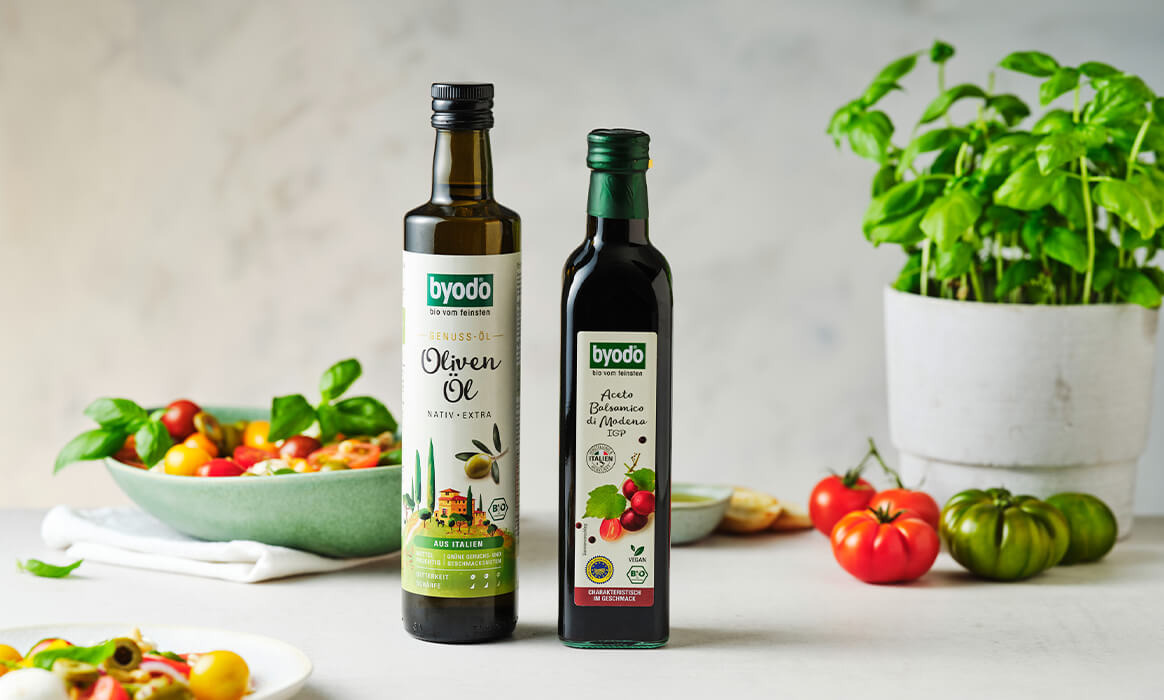
Aceto Balsamico di Modena IGP Our original Italian Byodo Aceto Balsamico di Modena IGP not only impresses in classics such as caprese (tomato and mozzarella), bruschetta or other Italian salads thanks to its unmistakable, intensely sweet and sour taste, but is also ideal for glazing meat or refining desserts such as a highlight on vanilla ice cream. It is made from Italian red wine vinegar and concentrated grape must, which gives it its dark color. Italian balsamic vinegar Icon
Byodo Aceto Balsamico di Modena IGP - Invecchiato Welle
Aceto Balsamico di Modena IGP - Invecchiato Our Invecchiato promises an even darker color and more intense taste. Unlike normal aceto, Invecchiato is matured in oak barrels - for three years! This makes it even thicker and more intense in flavor and goes well with fine salads and delicate sauces.

Our tip: It is simply delicious on pieces of Parmesan as an aperitif! To the Invecchiato Icon
Byodo Condimento Bianco Welle
Condimento Bianco & Rosso While the light Condimento Bianco is made from Italian white wine vinegar and sweet grape must, the Condimento Rosso is made from white wine vinegar, red wine vinegar and sweet grape must. The lighter Condimento goes well with light, color-sensitive dishes such as light salads, sauces or vegetable dishes. The intense red, fruity-sweet Condimento Rosso tastes great with crisp, fresh garden salads, as well as for seasoning and marinating hot and cold dishes. To the Condimenti Icon
Byodo Crema mit schwarzer Johannisbeere Welle
Cremas Cremas, on the other hand, are creamy, concentrated vinegar variants that are made on the basis of balsamic vinegar with a sweet and sour taste. Our Byodo cremas are available in the classic version, as well as with basil and in the fruity version with blackcurrant. The sweet and sour cremas are suitable for seasoning and refining salads or meat, fish and vegetable dishes as well as a dip for cheese or as a topping for desserts. To the Cremas Icon
Fruchtiger Balsamessig von Byodo Welle
Fruity balsamic vinegars The fruity balsamic vinegars bring freshness and a sweet and sour note to your dishes.
The apple balsamic goes perfectly with salads with nuts or cheese as well as for refining savory chutneys. The intensely fruity pomegranate balsam can be used to refine oriental dishes, fruity salads or marinades. Thanks to its strong berry aroma, Raspberry Balsam is perfect for leaf salads, goat's cheese or desserts. The tangy Lemon Balsam is ideal for light summer salads, fish dishes or for refining Mediterranean dishes thanks to its fine lemon note.

Our insider tip:
Delicious refreshing drinks can also be conjured up with our balsamic vinegars! Simply add a dash of organic balsamic vinegar to a glass of water and refine and decorate with fruit as desired! To the fruity balsamic vinegars Icon

Do you know the difference between white wine vinegar and Condimento Bianco?

At first glance, they seem similar, but white wine vinegar and Condimento Bianco differ significantly in terms of both taste and production. We’ll show you how.

Weißweinessig vs. Condimento Bianco - Kennst Du die Unterschiede?
Which one do you choose?
The two vinegars differ most in the way they are produced. While classic white wine vinegar is made from pure white wine, Condimento Bianco is a blend of the finest Italian white wine vinegar and sweet grape must. Due to the use of grape must, the Condimento Bianco also has a lower acidity and, in contrast to the classic vinegary white wine vinegar, has a fruity and sweet and sour taste.
Weißweinessig vs. Condimento Bianco - Kennst Du die Unterschiede?
The differences at a glance
The origin of the two vinegars also differs. Condimento Bianco, for example, is originally produced in Italy. The production of white wine vinegar, on the other hand, is not regionally bound. In terms of taste, Condimento Bianco goes perfectly with leaf salads and all warm meat and vegetable dishes and is also ideal for preparing fine Mediterranean dishes. Thanks to its higher acidity, white wine vinegar is preferred for pickling fruit and vegetables. However, it also tastes delicious in stronger salad dressings and marinades.

Would you like to find out more about Byodo vinegars?

This might also interest you

100% organic quality
Our premium standards do not end with our delicious products. Through numerous voluntary commitments and double quality assurance, we guarantee the finest organic produce.
Read more
Our product variety
Discover over 150 products in the best 100% organic quality. Our double quality assurance ensures maximum product safety. Here you will find more than just products - enjoy the taste of quality, pleasure and sustainability.
Discover now
Welle